

Access free equity research databases through Edmonton Public Library (EPL) with your library card. EPL provides Morningstar Investment Research Centre, Value Line, and Canadian Newsstand Complete at no cost. Reserve a computer at Stanley A. Milner Library downtown or log in remotely using your 14-digit barcode and PIN.
Request guest access to academic databases at University of Alberta’s Rutherford Library. Bloomberg Terminal stations are available to the public during business hours (call ahead: 780-492-3790). Bring government-issued ID and expect to complete a brief registration form. Sessions run two hours maximum, sufficient for screening Canadian equities and pulling financial statements.
Join Edmonton chapter investment clubs through MeetUp or the Canadian ShareOwner Association. Monthly meetings at Strathcona County Library and online forums provide peer-driven stock analysis, portfolio reviews, and guest speakers from local brokerage firms. Annual membership averages 50 dollars, with no minimum investment required.
Download research reports directly from discount brokerages. Questrade, Interactive Brokers, and National Bank Direct Brokerage offer equity research from CIBC Capital Markets, RBC Dominion Securities, and independent providers once you open an account. No trading activity required to access reports, though account minimums vary (zero to 1,000 dollars).
Pull regulatory filings from SEDAR Plus (sedarplus.ca) and EDGAR (sec.gov) for Canadian and U.S. listed companies. Annual information forms, management discussion and analysis, and insider trading reports are mandatory disclosures updated within 24 hours of filing. Cross-reference these primary sources against broker research to verify claims and identify gaps in third-party analysis.
This guide from dwgood.com evaluates each resource’s depth, timeliness, cost structure, and practical limitations for Edmonton-based self-directed investors.
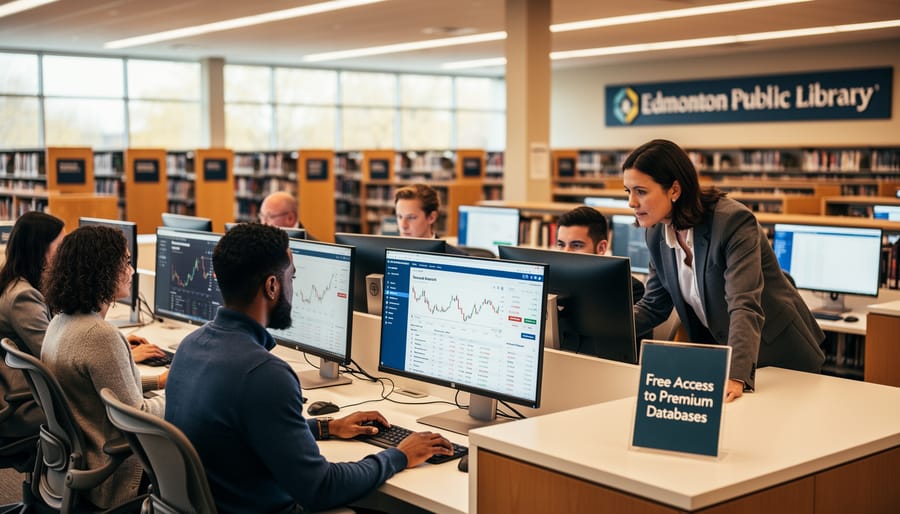
Edmonton Public Library Business Resources: Free Equity Research Access
Edmonton Public Library (EPL) cardholders gain complimentary access to three institutional-grade investment databases that retail subscribers typically pay $300 to $600 monthly to access. Mergent Intellect, Morningstar Investment Research Centre, and Value Line Research provide company fundamentals, analyst reports, and screening tools comparable to professional Bloomberg terminals, making library card access a substantive cost advantage for self-directed investors conducting sector-specific equity research.
Mergent Intellect delivers business intelligence on over 15 million public and private companies worldwide, including detailed financials, ownership structures, and merger activity. The platform enables custom screening by revenue, geography, industry classification (NAICS or SIC codes), and executive profiles. Investors building watch lists or conducting peer comparisons will find the export functionality particularly useful for ratio analysis and historical trend mapping.
Morningstar Investment Research Centre offers equity and mutual fund reports authored by Morningstar analysts, alongside quantitative star ratings (1 to 5) based on fair value estimates. Coverage spans approximately 3,000 North American equities and 8,000 funds. The Economic Moat ratings (None, Narrow, Wide) identify competitive advantages, while forward price-to-fair-value ratios highlight potential mispricing. Canadians researching cross-listed securities or RRSP-eligible U.S. holdings benefit from dual-market depth.
Value Line Research provides independent analysis on roughly 1,700 U.S. and 1,800 Canadian stocks through single-page reports that include 15-year historical financials, three- to five-year growth projections, and timeliness/safety ranks (1 to 5). The platform’s strength lies in its long-term data series for trend identification and its screening tools, which filter by dividend yield, beta, and earnings predictability.
| Database | Primary Data Type | Access Method | Best Use Case |
|---|---|---|---|
| Mergent Intellect | Financials, ownership, M&A data | In-library and remote | Peer screening, private company research |
| Morningstar Investment Research Centre | Analyst reports, fair value estimates | In-library and remote | Valuation context, moat analysis |
| Value Line Research | 15-year financials, growth projections | In-library and remote | Long-term trend identification, dividend screening |
Access procedures vary by database. Remote login requires an active EPL card and library PIN, entered at the EPL website’s databases portal. Some resources limit concurrent users, meaning peak-hour availability can fluctuate. In-library workstations bypass these queues and often provide faster data downloads for multi-company exports. Most sessions timeout after 15 to 30 minutes of inactivity, so saving interim work is necessary.
Limitations include geographic restrictions (Canada-only IP addresses for remote access) and session-based licensing that prohibits bulk data extraction or commercial redistribution. None of the platforms offer real-time market data or intraday charting, constraining their utility for short-term traders. However, for fundamental analysis and portfolio construction timelines measured in quarters or years, the depth and breadth rival paid alternatives without subscription overhead.
University of Alberta Financial Data Labs and Public Access
The University of Alberta’s Alberta School of Business maintains several financial data resources that community members can access under specific conditions, though expectations should remain realistic. Non-students cannot simply walk in and use premium tools as freely as enrolled learners, but limited opportunities exist for those willing to navigate eligibility requirements.
Bloomberg terminal access is restricted primarily to students, faculty, and staff with valid ONEcards. Alumni with active library borrowing privileges may request supervised sessions during business hours, subject to terminal availability. The Business, Education & Recreation Library houses terminals on the fourth floor of the Education North building. Sessions typically run 60 to 90 minutes, and advance booking through the library’s website is mandatory during peak academic periods (September through April). Expect waitlists during earnings season when MBA students monopolize stations for case competitions and coursework.
Public workshops offered by the school occur sporadically, averaging two to four events annually. Past sessions have covered portfolio construction fundamentals, sector rotation strategies, and equity valuation methodologies. These workshops target prospective students and alumni rather than the general public, though registration pages occasionally accept community participants on a space-available basis. Monitor the Alberta School of Business events calendar in late August and early January when programming schedules are finalized.
The Investment Management Club occasionally hosts guest speakers from local asset managers and publicly traded firms, but these sessions prioritize student members. Community attendance requires sponsor approval and advance registration, with no guarantee of admission.
Realistically, the university serves as a supplemental resource rather than a primary research hub for unaffiliated investors. Library databases and broker platforms deliver more consistent access without scheduling constraints or eligibility hurdles.
Local Investment Clubs and Peer Research Networks
Edmonton’s investing community offers structured peer networks where self-directed investors share research, compare strategies, and access guest speakers at minimal or no cost. These groups bridge the gap between solitary online research and expensive advisory services.
The Edmonton Investment Club, operating since the 1990s, meets monthly at the Stanley Milner Library. Members present individual stock pitches, debate valuation models, and critique portfolio positions using a collaborative research framework. Typical sessions include 30-minute stock presentations with supporting financials, followed by group discussion covering risks, catalysts, and sector headwinds. Membership runs approximately $50 annually, granting access to a shared research repository and email discussion threads. Meetings rotate between fundamentals-focused sessions (discounted cash flow analysis, balance sheet deep dives) and broader market commentary. New members submit an application through the club’s website, though attendance at two meetings as a guest is permitted before joining.
CFA Society Edmonton, the local chapter of the Chartered Financial Analyst Institute, hosts events open to non-members at $40 to $75 per session. Monthly programs feature portfolio managers, equity analysts, and economists discussing sector outlooks, emerging risks, and valuation trends. Recent topics included energy transition impacts on Canadian oil and gas equities, Bank of Canada rate policy implications for financials, and small-cap opportunities in Western Canada. Non-CFA charterholders gain structured access to experienced practitioners without full membership fees (approximately $350 annually). Event schedules appear on the society’s website three months in advance.
These networks suit investors seeking accountability structures and diverse perspectives. Club formats force articulation of investment theses, expose blind spots through peer critique, and provide networking with professionals managing personal portfolios. However, they require regular time commitments (typically two to three hours monthly) and geographic proximity to Edmonton venues. Research quality varies by participant expertise, so due diligence on all shared ideas remains essential. For those willing to engage actively, investment clubs offer low-cost exposure to multiple research approaches and real-world portfolio management discussions unavailable through solitary analysis.

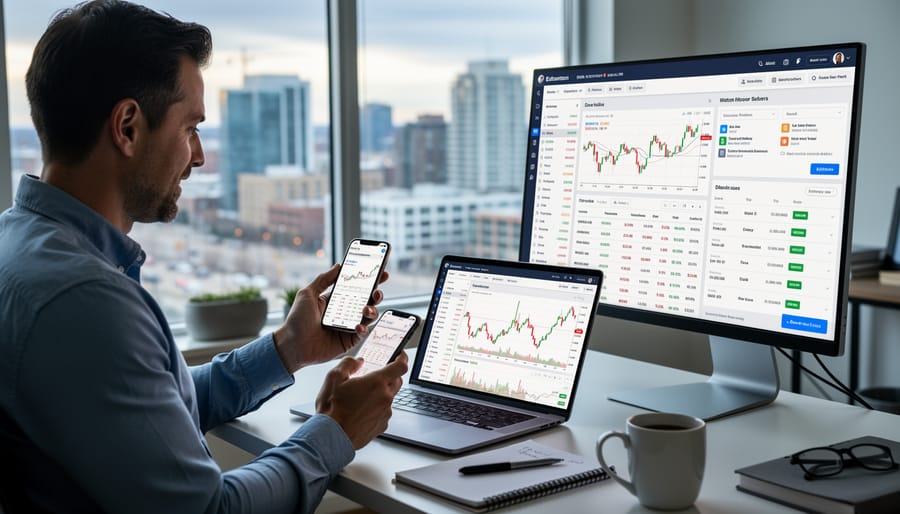
Broker-Provided Research for Edmonton Residents
Canadian-Focused Research Platforms
For Edmonton investors tracking local energy producers, Canadian lithium stocks and junior miners, several platforms provide dedicated Toronto Stock Exchange (TSX) and TSX Venture Exchange (TSX-V) coverage that mainstream U.S.-centric tools overlook.
Questrade and Interactive Brokers Canada both offer commission-free trading on TSX-listed equities and provide real-time Canadian market data without additional fees. Questrade’s IQ Edge platform includes Level 2 quotes for TSX and TSX-V names, valuable for assessing liquidity in thinly traded junior resource stocks common in Alberta portfolios. Interactive Brokers supplies comprehensive fundamental data on over 3,000 TSX-V issuers, including cash flow statements and insider transaction histories often absent from Yahoo Finance or Google Finance.
For research depth, TMX Money (operated by the Toronto Stock Exchange) publishes free daily trading summaries, insider filings, and company financials for all listed Canadian equities. The platform’s “Market Activity Report” tracks sector-specific volume and price changes, useful for identifying momentum in oil and gas or mining sector analysis. SEDAR+ (System for Electronic Document Analysis and Retrieval) remains the official repository for all public company filings, including prospectuses, material change reports, and annual information forms required under National Instrument 51-102.
Morningstar Premium Canada costs CAD 24.95 monthly and covers approximately 850 TSX-listed companies with analyst reports, fair value estimates, and economic moat ratings. Coverage skews toward large-cap energy and financial names but includes select mid-cap industrials and materials producers relevant to Edmonton’s economic base. The Edmonton Public Library provides free access to Morningstar’s database through its online portal for cardholders, eliminating subscription costs for residents.
Alberta Securities Commission Investor Education and SEDAR+ Filings
The Alberta Securities Commission maintains public access to comprehensive company filings through SEDAR+ the national electronic database that replaced SEDAR in June 2023. Every public company operating in Canada must file quarterly financials, annual reports, material change notices, and insider trading disclosures here. For Edmonton-based investors, this represents a zero-cost competitive advantage: the same documents institutional analysts review are available the moment companies release them.
The system contains four document types most relevant to equity research. Quarterly financial statements (Form 51-102F1) and management discussion and analysis (MD&A) provide revenue trends, margin data, and forward guidance every 90 days. Annual information forms (AIF) describe business risks, competitive position, and regulatory exposure in detail. Material change reports flag significant corporate events such as acquisitions, litigation, or executive departures within days of occurrence. Insider trading reports reveal when directors and officers buy or sell shares, offering directional signals about management confidence.
Extracting actionable data requires a systematic approach:
- Navigate to SEDAR+ and enter the company name or ticker in the search field. Filter results by document type to avoid sifting through hundreds of unrelated filings.
- Start with the most recent MD&A. Read the “Results of Operations” section for revenue breakdowns by segment and the “Liquidity and Capital Resources” section for cash flow trends and debt covenants.
- Compare the current quarter’s key metrics (gross margin, operating expenses as a percentage of revenue, free cash flow) against the prior four quarters. Identify acceleration or deceleration.
- Review material change reports filed in the past 12 months. A cluster of reports around executive turnover or regulatory inquiries warrants caution.
- Check insider trading reports for patterns. Consistent buying by multiple insiders carries more weight than a single transaction. Note the price at which insiders transacted relative to current levels.
- Cross-reference the AIF’s risk factor disclosures against recent news. Has a disclosed risk materialized?
SEDAR+ filings don’t interpret data for you. A company reporting flat revenue might be executing a margin expansion strategy, or it might be losing market share. The MD&A typically explains which. Download PDF versions of financials to your device for offline markup and comparison across periods. Most quarterly reports run 30 to 50 pages, but the critical data occupies fewer than ten.
Free and Low-Cost Online Platforms with Canadian Market Coverage
Several national and international platforms deliver Toronto Stock Exchange (TSX) and TSX Venture Exchange (TSX-V) data and analysis without subscription fees or at minimal cost, serving Edmonton investors who require broad market coverage beyond local broker tools.
Yahoo Finance Canada offers delayed quotes for all TSX and TSX-V securities at no cost, typically running 15 minutes behind live markets. The platform provides historical price charts, basic fundamental data (price-to-earnings ratio, dividend yield, market capitalization), and news aggregation from Canadian financial media. Screening tools allow filtering by sector, valuation metrics, and performance thresholds, though the interface lacks advanced customization. Community discussion boards attract variable-quality commentary and remain unmoderated for accuracy. The mobile app replicates desktop functionality with push notifications for watchlist price alerts.
TMX Money, operated by TMX Group which runs the TSX and TSX-V, supplies official delayed quotes (15 minutes), comprehensive corporate filings, and insider trading reports directly from exchange databases. Real-time data requires a paid subscription starting at 9.95 Canadian dollars monthly. The platform’s strength lies in regulatory documents, dividend histories, and ownership structure data unavailable on aggregator sites. Charting remains rudimentary compared to dedicated technical analysis tools. For AI stock research or sector-specific analysis, users must supplement TMX Money with third-party screening capabilities.
Investing.com covers Canadian equities alongside global markets, providing delayed TSX quotes, economic calendar events, and analyst consensus estimates. The free tier includes customizable charts with 50-plus technical indicators, portfolio tracking across multiple accounts, and comparison tools for peer benchmarking. Real-time data and advanced alerts require premium subscriptions from 12.99 USD monthly. The platform’s strength is cross-asset correlation analysis, useful for investors examining commodity price impacts on Calgary-headquartered energy stocks or currency effects on exporters.
TradingView’s free tier grants three indicators per chart, single-device access, and delayed Canadian exchange data. The social network features allow users to publish ideas, review others’ technical analysis, and filter content by accuracy track record. Pine Script programming enables custom indicator creation even on free accounts. Paid plans (14.95 to 59.95 USD monthly) unlock real-time TSX data, multiple chart layouts, and volume profile tools favored by active traders.
Each platform serves distinct use cases. Fundamental investors prioritize TMX Money for filings and Yahoo Finance for screening. Technical traders gravitate toward TradingView’s charting depth despite delayed data. Cross-referencing multiple free sources compensates for individual platform limitations without recurring costs.

Risks and Limitations of Free and Local Resources
Free and community resources available to Edmonton investors deliver substantial value, but they impose concrete tradeoffs that self-directed investors must recognize and mitigate. The primary limitation is data latency: many library databases refresh quotes on a 15- to 20-minute delay, and community-shared research often lags real-time market developments by hours or days. For long-term equity investors, these delays rarely alter fundamental thesis development, but they create blind spots during earnings announcements, regulatory filings, or sudden sector rotations.
International coverage presents another constraint. Edmonton Public Library’s Morningstar and Value Line subscriptions focus heavily on North American equities, with limited depth on European or emerging-market stocks. Investors building globally diversified portfolios will find Canadian small-cap coverage robust but Asian equities underrepresented. University databases at the University of Alberta expand this reach modestly, yet still fall short of Bloomberg or FactSet breadth.
Free broker research platforms introduce potential conflicts of interest. The firms publishing these reports often earn commissions on trades or maintain investment banking relationships with covered companies, creating subtle biases toward buy ratings. A 2022 study published in the Journal of Financial Economics found that free broker research assigns “buy” ratings three times more frequently than independent sources. Edmonton investors should compare broker conclusions with independent analyses and scrutinize disclosure footnotes for compensation arrangements.
Community investment clubs and Reddit-style forums offer valuable peer perspectives but lack accountability structures. Unverified claims, survivorship bias (members highlight wins and hide losses), and groupthink dynamics can distort risk perception. Effective mitigation requires triangulating ideas across at least three independent sources: regulatory filings, third-party financial data providers, and contrarian viewpoints. Track each source’s historical accuracy and adjust reliance accordingly. No single free resource delivers the proprietary screening algorithms or real-time alerts that institutional platforms provide, so disciplined investors build redundancy into their research workflows and allocate extra time to manual verification.
Edmonton investors have access to a practical, cost-effective toolkit for equity research. By combining free regulatory databases, public library subscriptions, broker-provided analytics, and local knowledge-sharing networks, self-directed market participants can build workflows that rival expensive premium platforms.
The strategy hinges on four core components. First, Edmonton Public Library (EPL) cardholders gain immediate access to Morningstar Investment Research Centre, Value Line, and Financial Post Advisor, eliminating the need for individual subscriptions that cost hundreds or thousands annually. Second, SEDAR+ and the U.S. Securities and Exchange Commission (SEC) EDGAR database provide unfiltered access to financial statements, management discussion and analysis (MD&A), and insider transaction reports. Third, discount brokers such as Questrade, Interactive Brokers, and major Canadian banks offer complimentary screening tools, earnings calendars, and analyst consensus data to account holders. Fourth, Edmonton investment clubs and University of Alberta seminars create opportunities to test theses, share due diligence, and learn from peers without transactional bias.
Actionable next steps:
– Obtain an EPL library card (free for Alberta residents) and bookmark the Business and Finance databases page
– Add SEDAR+ to browser favorites and review filing requirements for Canadian issuers
– Join one Edmonton-based investment club or attend a university investor relations event within 30 days
– Configure free stock screeners at Finviz or Yahoo Finance with sector-specific criteria
This integrated approach delivers institutional-quality research inputs at minimal cost, positioning Edmonton investors to make informed allocation decisions grounded in primary sources and community insight.





+ There are no comments
Add yours